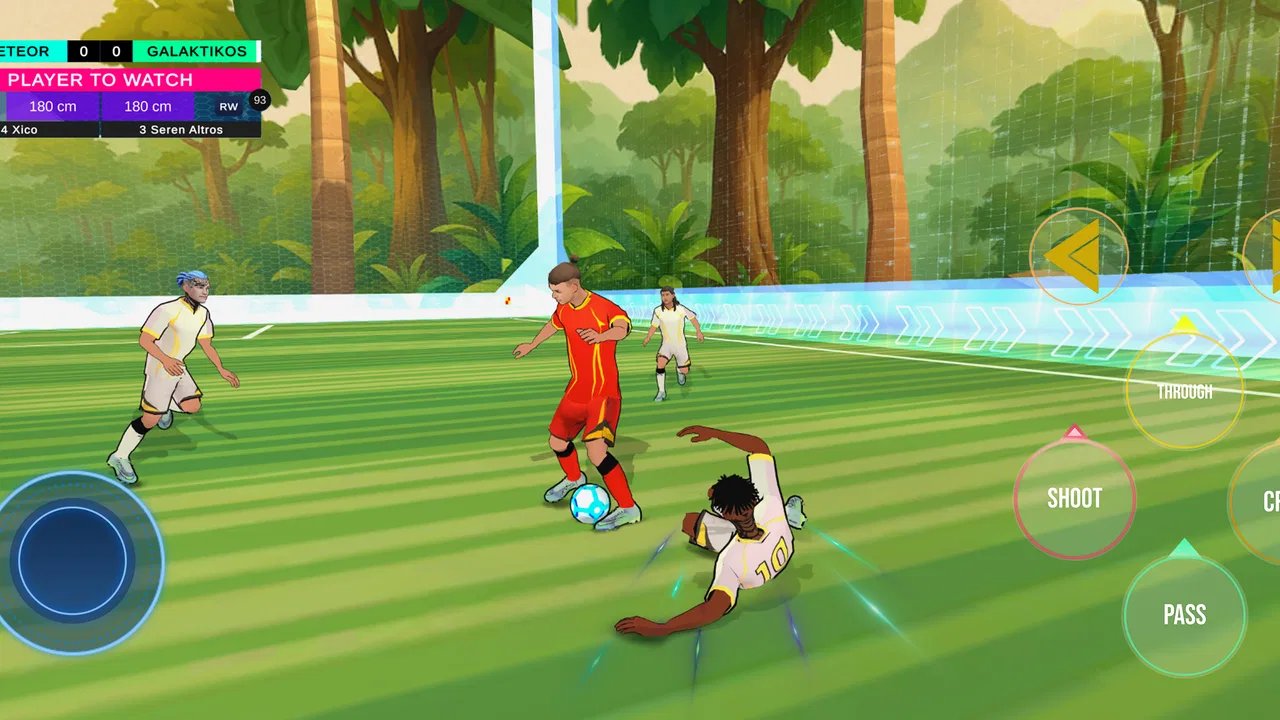
Galaxy Soccer : 3v3 Battle
- 4.1
- Rating
- 1.00M
- Installs
- Free
- Price

 Analysis by App-foxy
Galaxy Soccer: 3v3 match is the kind of sports game I open when I want a quick burst of football action rather than a long career mode or a serious simulation. Its central promise is simple: get into a match, make a few important plays, and start again almost immediately. That compact structure gives it an appealing pick-up-and-play character, especially on a phone.
I found the game easiest to understand when I stopped expecting a full eleven-a-side football experience. This is a smaller, faster format built around short decisions, quick movement, and the satisfaction of turning one good opportunity into a goal. The result is more casual arcade football than detailed management or realistic match recreation.
It is a free sports game from peniaApps, rated for Everyone, and it runs on Android devices using version 7.0 or later. The current version is 2.4.1, while its average score sits at 3.7 from around 1.9 thousand ratings. Those figures suggest a game with a reasonable audience but also a mixed experience, which matches my impression: the basic idea is immediately accessible, although its simplicity will not suit every football fan.
You May Also Like

 Google Keep - Notes and lists
Google Keep’s Quiet Growth Shows the Appeal of Simpler Notes
As mobile work gets busier, Google Keep keeps winning a simple contest: capture a thought quickly, find it later, and get on with the day.

 Blood Strike: 2.5 Anniversary
Blood Strike’s Loadouts Turn Every Drop Into a Tactical Gamble
A close look at Blood Strike’s custom loadouts: how fast access to signature weapons reshapes its battle royale rhythm, rewards preparation, and narrows the gap between fights.

 Pandora - Music & Podcasts
Pandora’s Music Is Easy to Start, but Harder to Recover
Pandora’s strength is its low-effort path from a seed to a station. Its weak spot is how much confidence it asks you to place in connection, setup, and quiet recovery.

 8 Ball Pool
 Is Built on Rivalries, Rematches, and Routine
A close look at the rivalries, rematches, shared routines, and unanswered safety questions that turn a quick pool match into a persistent mobile community.

 Samsung Music
’s Quiet Strength Is Playing What You Already Own
Its reach comes less from spectacle than from dependable access to a personal library. That simplicity is both the app’s strongest retention engine and its ceiling.

 AccuWeather: Weather Radar
AccuWeather Review: A Quick, Clear Forecast for Everyday Decisions
For everyday plans, the best forecast is the one you can understand quickly. AccuWeather makes rain timing, radar, and local conditions easy to act on, with a few trade-offs.
More From Our News Desk



How the first action sets the tone
The first useful thing to do is simply begin a match and pay attention to how much responsibility is placed on each play. With only three players per side, there is less room to disappear into the formation. A misplaced move or a slow reaction can matter quickly, but a well-timed action can also change the direction of the entire exchange.
That makes the opening moments more active than the setup suggests. I was not waiting for a long build-up before something happened. The game encourages me to look for an immediate opening, react to the opponent, and keep moving instead of treating possession as a slow puzzle. If you enjoy football games because of their instant pressure, this compact format gets to that feeling quickly.
The smaller team structure also changes how I think about space. In a traditional football game, I can rely on several teammates to cover mistakes or create passing options. Here, every available player feels more important. I found myself watching the position of the whole small group rather than focusing only on the ball, because leaving a gap can make the next attack uncomfortable.
That is one of the game’s less obvious strengths. The reduced scale does not automatically make the match mindless. It removes some of the complexity of a full simulation, but it leaves enough room for timing and awareness to matter. A player who rushes every action may create chances, but will also give the other side easy opportunities.
I would recommend starting with a patient first minute, even if the match feels fast. Use the opening exchange to learn how quickly players respond and how much space is available after an unsuccessful move. This is more useful than immediately trying to force a spectacular attack. Once I understood the rhythm, the three-player format felt less chaotic and more deliberate.
The “Galaxy” identity gives the game a lighter, more playful presentation than a licensed football title. That matters because it sets the right expectation. I would not install this looking for real clubs, authentic competitions, or a deep roster-management system. I would install it for a focused match loop that can be understood without studying a large menu of options.
Why the small format works on a phone
Mobile football often has to balance action with the limitations of a touchscreen. A match that demands too many simultaneous decisions can become tiring or awkward, particularly when playing with one hand or during a short break. The 3v3 concept helps by narrowing the number of moving parts.
In everyday use, I can imagine playing a match while waiting for transport or taking a short break between tasks. The important point is not that every session will be identical in length, but that the game is designed around a low commitment. I can try one match without promising myself a full evening of play.
That convenience is also its first major trade-off. If you want a deep football hobby with long-term planning, the compact structure may feel thin. The same design choice that makes a quick session comfortable can make the experience less satisfying for someone who wants detailed tactics, player development, or a realistic match atmosphere.
Reading the feedback instead of chasing the ball
The best matches create a clear feedback rhythm: I act, I see the result, I adjust, and the next chance appears. Galaxy Soccer: 3v3 match is most enjoyable when I treat that rhythm as the main attraction rather than trying to win through constant movement.
A successful attack gives immediate confirmation that my timing or positioning worked. A failed play is useful when it shows what went wrong: I moved too early, left too much space, or tried to force a route that was not available. That kind of feedback makes another attempt feel justified because I have something specific to change.
My practical tip is to alter one decision at a time. If an attack fails, do not change movement, timing, and direction all at once. Try approaching the next opportunity more slowly, then compare the result. This turns a short match into a small learning cycle instead of a string of random attempts.
The 3v3 setup is particularly good for noticing cause and effect. There are fewer players to blame and fewer layers between a decision and the outcome. When a gap appears, I can usually connect it to a recent choice. That clarity is valuable for casual players because it lets them improve without needing a complicated tactical vocabulary.
At the same time, the feedback is not always enough to satisfy players who want detailed explanations. A football simulation can show statistics, formations, player attributes, and match reports that explain performance over time. A compact arcade game has less room for that kind of analysis. If you prefer reviewing every aspect of a match, a more traditional football title will probably be a better fit.
The reward is the next opportunity
For me, the main reward in this kind of game is not a trophy cabinet or a long career narrative. It is the feeling that a clean sequence of decisions produced a visible result. A well-timed move, a useful pass, or a goal can make a short match feel worthwhile even when there is no elaborate story around it.
This is where the instant-rematch idea becomes important. The game’s appeal comes from reducing the distance between disappointment and another chance. If I lose because I made a poor decision, I do not need to wait long before trying a different approach. That makes failure less frustrating than it would be in a longer, slower football game.
I also like the way this structure encourages small personal goals. One session might be about avoiding rushed attacks. Another might focus on protecting space after losing possession. A third might simply be about seeing whether I can maintain composure when the match becomes hectic. These goals are not formal objectives, but they give repetition a purpose.
That said, the reward loop depends heavily on whether the basic match handling feels comfortable to you. If you dislike the way the players respond or find the action too limited, quick rematches can expose that weakness rather than solve it. Repetition is powerful only when the underlying controls and pace are enjoyable.
The free price makes experimentation easy. I can try it without treating the download as a major commitment, and the Everyone rating makes it suitable for a broad audience. Parents should still decide whether the fast competitive loop is appropriate for a particular child’s habits, but the rating itself makes the game approachable for general family use.
What happens when a session resets
The reset is the heart of the experience. A match ends, the immediate result is clear, and the temptation is to start another one while the previous decision is still fresh. That is a smart structure for mobile play because it keeps the game from demanding a large block of uninterrupted time.
I found the reset most satisfying after a close match. When the result feels connected to a handful of moments, starting again feels like a genuine rematch rather than simply repeating a routine. I can remember the mistake that cost me an opportunity and try to correct it immediately.
There is also a useful emotional balance here. A quick loss can be annoying, but it does not have to ruin the entire session. The next match offers a clean mental slate. Conversely, a win does not necessarily end the session because I may want to test whether I can reproduce the same decisions against a different flow of play.
The weakness is that a reset-based game can become repetitive if the matches do not develop enough variety for your taste. Players who need a strong progression system, a large collection of modes, or a persistent team-building layer may eventually feel that the reset erases too much. The game is strongest when you value the moment-to-moment contest more than the accumulation of long-term rewards.
For that reason, I would use it as a companion game rather than my only football game. It works well between longer activities, while a full simulation remains better for a weekend session built around team management and extended competition. Comparing it with the usual alternatives makes its position clear: it sacrifices depth and realism for speed, accessibility, and a shorter route back into action.
Who should play and who should skip it
I think Galaxy Soccer: 3v3 match is a good choice for someone who wants football action without learning a large system first. It suits players who enjoy quick retries, compact matches, and decisions that produce an immediate response. It is also a reasonable option for a casual player who does not want to spend money before discovering whether the format works for them.
It is less suitable for a fan who expects real-world teams, authentic leagues, detailed player careers, or the slower tactical control of a simulation. It may also disappoint anyone who needs a strong story or a long progression path to stay interested. The game’s identity is built around the match itself, so players who find repetition boring should approach it cautiously.
One useful way to decide is to ask what you want from a football game during a normal weekday. If you want ten minutes of direct action and the option to try again after a mistake, this format makes sense. If you want to build a squad, compare statistics, and manage a season, choose a deeper alternative instead.
Practical advice for getting more from each match
My first recommendation is to avoid treating every possession as an emergency. The small pitch and small teams can make the action feel urgent, but rushing every decision removes the opportunity to see how space changes. Give yourself a moment to identify the safer option before attempting a risky attack.
Second, use the rematch as a controlled experiment. If you conceded because your players were too far forward, spend the next match protecting that area rather than trying to score more quickly. This approach makes the game feel more strategic and prevents the familiar mobile habit of repeating the same move while hoping for a different result.
Third, stop after a few matches if your decisions become automatic. The short-session design makes it easy to keep tapping “rematch,” but fatigue can turn a readable game into a frustrating one. Taking a break and returning later can restore the sense of timing that makes the action satisfying.
Finally, keep the game in the right category in your mind. It is a sports game, but not a replacement for every type of football experience. Its value comes from the focused 3v3 contest and the short distance between action, result, and another attempt. Expecting it to behave like a full console-style simulation would make its limitations seem larger than they need to be.
My verdict on the complete loop
Galaxy Soccer: 3v3 match succeeds when its loop stays compact: I enter a match, make a quick decision, receive immediate feedback, take the result, and decide whether the next attempt might go better. That sequence is easy to understand and well suited to the stop-and-start way many people play on mobile.
Its strongest quality is the way the small team format makes each action feel relevant. Its biggest limitation is the same design choice: players looking for extensive content or serious football simulation may run out of reasons to continue. The game does not need to become something larger to be enjoyable, but it does require the right expectations.
With over half a million installs, it has clearly found an audience for its accessible approach. I would recommend trying it if you want a free, Everyone-rated football game from peniaApps that gets you back into a match quickly. The best reason to play is not a complicated progression system; it is the immediate chance to learn from one play and test that lesson in the next match.
My final recommendation is therefore positive but specific. Choose it for quick 3v3 action, instant recovery after a loss, and a lightweight football session that fits around daily life. Skip it if your idea of the perfect sports game involves licensed realism, deep management, or a long campaign. For the right player, the reset is not a lack of content—it is the reason another session begins.
FAQs for Galaxy Soccer : 3v3 Battle
01What is Galaxy Soccer: 3v3 Match about?
Galaxy Soccer: 3v3 Match is an exciting multiplayer game that combines soccer with a cosmic twist. Players engage in fast-paced 3-on-3 matches, controlling unique characters with special abilities. The game is set in vibrant intergalactic arenas, enhancing the fun and competitive spirit among friends or players worldwide.
02Is Galaxy Soccer: 3v3 Match free to play?
Yes, Galaxy Soccer: 3v3 Match is free to download and play on both Android and iOS devices. While the core features are accessible at no cost, there are in-app purchases available. These may include cosmetic items, character upgrades, or other enhancements to enrich the gaming experience.
03What are the system requirements for Galaxy Soccer: 3v3 Match?
Galaxy Soccer: 3v3 Match requires a stable internet connection for online play. For Android users, a device running Android 5.0 or higher is recommended, while iOS users will need a device with iOS 11.0 or later. Ensure your device has adequate storage space for smooth installation and gameplay.
04Can I play Galaxy Soccer: 3v3 Match with friends?
Absolutely! Galaxy Soccer: 3v3 Match emphasizes multiplayer gameplay, allowing you to team up with friends or compete against them. You can invite friends to join your team or challenge them in matches, making it a perfect game for social play and friendly competition.
05Are there different modes or levels in Galaxy Soccer: 3v3 Match?
Galaxy Soccer: 3v3 Match offers various game modes to keep players engaged. Whether you prefer casual matches or more competitive ranked modes, there’s something for everyone. The game also includes special events and challenges, providing opportunities to unlock rewards and climb leaderboards.
Pros
- Smooth gameplay with intuitive controls.
- Vibrant graphics enhance user experience.
- Quick matchmaking for instant play.
- Diverse character customization options.
- Frequent updates with new features.
Cons
- Limited offline play options available.
- Occasional connectivity issues.
- In-app purchases can be pricey.
- Ads can be intrusive during gameplay.
- Lacks a detailed tutorial for beginners.

Galaxy Soccer : 3v3 Battle
Gallery